For nearly a decade, astronomers have been chasing a ghost.
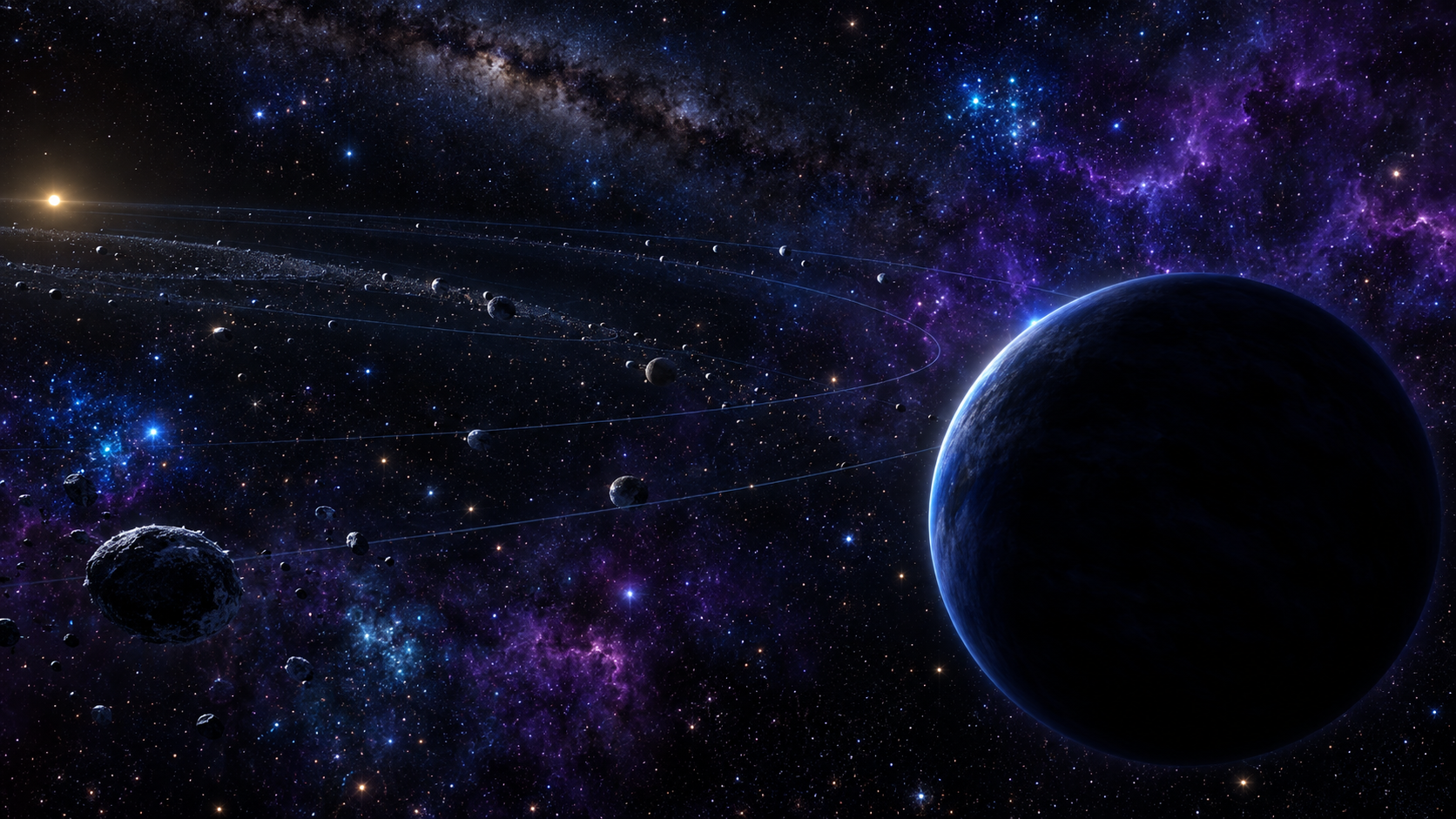
Out beyond Neptune, in the cold dark of the outer solar system, a small group of icy objects move in orbits that don’t quite make sense. The simplest explanation — proposed back in 2016 — was that an unseen, Neptune-sized world was tugging on them. They called it Planet Nine.
Now, a new study reported by ScienceDaily has thrown a fresh wrench into the hunt: a recently discovered object’s orbit doesn’t behave the way the Planet Nine hypothesis would predict. In other words, the evidence is getting weirder, not cleaner.
Why this matters
If Planet Nine exists, it would be the first major planet discovered in our solar system since Neptune in 1846. That’s 180 years. Finding it would rewrite the textbooks — and tell us something fundamental about how solar systems like ours actually form.
If it doesn’t exist, then something else is shaping those strange orbits — and that “something else” might be even more interesting. A swarm of small bodies? A primordial black hole? Leftover physics we don’t yet understand?
What’s next
The new Vera C. Rubin Observatory in Chile is now coming online and is expected to dramatically accelerate the search. It will image the entire visible southern sky every few nights, catching faint, slow-moving objects that earlier surveys missed. If Planet Nine is out there, Rubin is the best chance we’ve ever had of catching it. If it isn’t, Rubin should be able to put that to bed too.
Either way, the next few years are going to be a great time to be a night owl.