
You’ve spent some time looking up with your own eyes. You can pick out the Moon, notice a bright planet, and maybe recognize a few familiar stars.
Now you’re ready to see more.
The good news: your first telescope does not need to cost thousands of dollars: or require an astronomy degree. A modest telescope can bring the Moon’s craters, Jupiter’s moons, Saturn’s rings, and bright star clusters a little closer. You only need a clear view, a reasonably dark spot, and a bit of patience.
We gathered 10 options from Amazon’s Best Sellers in Telescopes list, checked on September 13, 2026. Every pick is under $500, and we’ve organized them by price so you can find a comfortable place to begin.
Prices, ratings, and review counts reflect the list snapshot above and may change.
Before you shop: three telescope terms in plain English
You’ll see a few unfamiliar words in telescope listings. Here’s the useful version.
- Refractor: Uses a lens at the front. These are usually simple to set up and friendly for viewing the Moon and planets.
- Reflector: Uses a mirror instead of a front lens. Reflectors often offer more light-gathering power for the money, which can help with star clusters and brighter nebulae.
- Smart or smartphone-guided telescope: Usually means the telescope works with an app that helps you find objects. It does not necessarily mean the telescope observes by itself. You still point and focus it, but your phone can act like a helpful sky map.
Pay attention to aperture, too. That is the width of the telescope’s main lens or mirror. Bigger aperture means more light, which generally means brighter and more detailed views.
One more tip: bigger magnification is not automatically better. A blurry view at 200× is much less useful than a sharp view at 60×. Start with the lowest-power eyepiece, find your target, and increase magnification slowly.
Start Here: budget telescopes under $100
These four picks are good places to begin if you want a straightforward budget telescope under $100. They are compact refractors designed for casual stargazing, travel, families, and first nights outside.
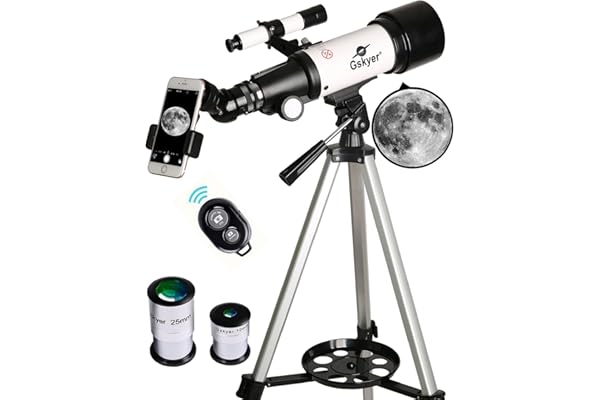
1. Gskyer Telescope 70mm Aperture 400mm AZ Refracting
- Price: $96.99
- Rating: 4.3 stars
- Reviews: 22,066
This is a sensible first step if you want a familiar, all-purpose beginner setup. Its 70mm aperture gathers enough light for satisfying lunar views and bright planets, while the shorter tube and included carry bag make it easier to move around.
The kit also includes a phone adapter and wireless remote, which can make simple Moon photos less fiddly. Think of it as a friendly introduction rather than a telescope you’ll need to “grow into.”
Best for: An inexpensive first telescope with a large number of customer reviews.
2. Celestron Travel Scope 70mm with Backpack
- Price: $89.99
- Rating: 4.2 stars
- Reviews: 14,800
The Travel Scope 70mm is aimed at people who want to take their telescope beyond the backyard. The included backpack helps with that: whether you’re heading to a campsite, a darker rural road, or simply the other side of the house.
As a 70mm refractor, it is a natural match for the Moon, bright planets, and daytime landscape viewing. Setup is uncomplicated, which matters when you’re eager to start looking up.
Best for: Portability and quick setup.
3. Koolpte Telescope 80mm Aperture 600mm
- Price: $90.24
- Rating: 4.3 stars
- Reviews: 3,972
This model gives you an 80mm aperture while staying below $100. That extra width can collect a little more light than a 70mm telescope, although the difference will not turn every faint galaxy into a bright target.
You get the usual beginner-friendly extras, including a tripod, carrying bag, phone adapter, and wireless control. For a first telescope, that makes the package approachable without adding much complexity.
Best for: A slightly larger aperture at an under-$100 price.
4. Celticbird Telescope 80mm Aperture 600mm AZ Refractor
- Price: $99.99
- Rating: 4.3 stars
- Reviews: 865
The Celticbird is another 80mm refractor with a 600mm focal length. In everyday language, that means it is built for pleasing views of bright targets rather than for chasing the faintest objects in the sky.
Its backpack, phone adapter, and Moon filter make it a practical family or travel kit. If you like the idea of stepping outside with a small bag rather than managing a bulky instrument, this one is worth a look.
Best for: A portable 80mm setup right at the top of the under-$100 tier.
Worth a Bit More: budget telescopes under $200
Moving into the $100–$200 range can give you a little more aperture, a longer tube, or a more substantial kit. These are still approachable choices for astronomy beginners.
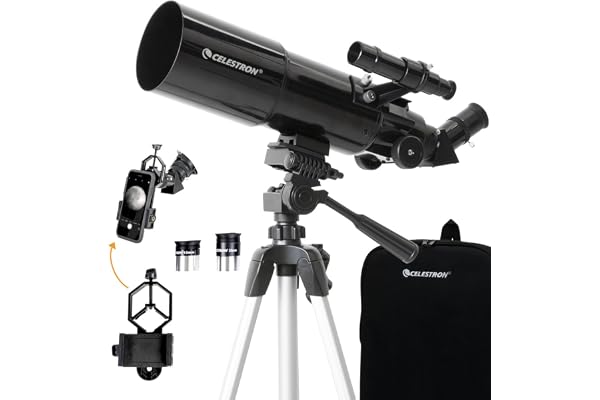
5. Celestron Travel Scope 80mm Kit with Backpack
- Price: $116.99
- Rating: 4.2 stars
- Reviews: 1,789
The Travel Scope 80mm is a modest step up from the 70mm version. Its larger aperture is useful when you want a little more light for star clusters and bright deep-sky objects, while the refractor design remains easy to understand.
The backpack and smartphone adapter keep the kit travel-friendly. This is a good middle ground if the under-$100 models feel a little basic but you still want a simple first telescope.
Best for: A portable refractor with a bit more light-gathering ability.
6. 90mm Telescope 600mm 180X Refractor
- Price: $139.99
- Rating: 5.0 stars
- Reviews: 14
This 90mm refractor offers a larger aperture than the entry-level 70mm models and advertises magnification up to 180×. Remember, though: you probably will not use the highest setting on every night. Atmospheric turbulence can make high-power views shimmer or blur.
The 5.0-star rating is based on just 14 reviews, so treat it as an early signal rather than a settled verdict. Still, the combination of a 90mm lens, adjustable tripod, phone adapter, and carry bag makes it an interesting option at this price.
Best for: A larger refractor at a moderate price, with the caveat of a small review sample.
7. Dianfan Telescope 90mm Aperture 800mm
- Price: $169.99
- Rating: 4.3 stars
- Reviews: 723
The Dianfan pairs a 90mm aperture with an 800mm focal length. That longer design can be well suited to Moon and planet viewing, where you want a more detailed look at bright targets.
It includes a stainless-steel tripod, phone adapter, and carry bag. If your main goal is to make the Moon feel less like a distant white disc and more like a landscape with shadows and edges, this is a promising step up.
Best for: Lunar and planetary viewing with a larger refractor.
8. MEEZAA Telescope 90mm Aperture 800mm
- Price: $199.99
- Rating: 4.4 stars
- Reviews: 832
The MEEZAA offers the same useful 90mm aperture and 800mm focal length combination, along with fully multi-coated optics, an AZ mount, tripod, phone adapter, and carrying bag.
This is a comfortable choice if you want to stay below $200 but would rather buy a larger refractor than a compact 70mm model. Start with the Moon, then try bright planets and open star clusters as you become more comfortable finding and focusing targets.
Best for: A fuller beginner kit at the top of the under-$200 range.
The Smart-Telescope Splurge: budget telescopes under $500
These final two picks use Celestron’s StarSense system. Your smartphone helps guide you toward celestial objects, which can shorten the frustrating “I know it’s somewhere over there” stage of stargazing.

9. Celestron StarSense Explorer LT 114AZ Smartphone Guided Telescope
- Price: $239.99
- Rating: 4.1 stars
- Reviews: 1,568
The LT 114AZ is a reflector with a 114mm aperture, giving it more light-gathering ability than the smaller refractors above. Its StarSense smartphone guidance can help you locate objects without relying entirely on printed charts or memorized constellations.
This is still a manual telescope: you move it yourself: but the app helps point you in the right direction. That makes it a useful bridge between casual viewing and more ambitious backyard astronomy.
Best for: More aperture plus smartphone assistance under $250.
10. Celestron StarSense Explorer DX 130AZ Smartphone Guided Telescope
- Price: $414.99
- Rating: 4.1 stars
- Reviews: 1,015
The DX 130AZ is the biggest and most expensive telescope in this roundup, with a 130mm reflector and StarSense smartphone guidance. That larger mirror can collect considerably more light than a 70mm refractor, opening the door to brighter views of clusters and some deep-sky objects in a dark location.
It is a good choice if you want your first telescope to leave room for exploration. You will still learn the basics: steady movement, focusing, choosing useful magnification: but the app can make it easier to find your next target.
Best for: A more capable first telescope under $500 with guided object finding.
How to start your first night
Keep the first outing simple.
- Begin with the Moon. It is bright, easy to find, and full of detail. Try looking along the line between light and shadow, where craters stand out best.
- Use the lowest magnification first. Find the target, center it, and focus before switching eyepieces.
- Move on to bright planets. Depending on the season, Jupiter, Saturn, Venus, or Mars may be your next stop.
- Give your eyes time to adjust. Avoid bright phone screens when you can, and keep a dim red light nearby if you need to read a chart.
- Expect the sky to move. Objects drift across the view because Earth is turning. That is normal: and part of the fun.
You do not need perfect skies or expensive gear to begin. You need one clear evening and a reason to step outside.
If you are still deciding, start with a simple refractor under $100. If you want more light, look at the 90mm options. If finding objects sounds like the hardest part, consider a StarSense model. And once your telescope arrives, check what’s happening in tonight’s sky before you head out.
Your first view may be the Moon’s craters, Jupiter’s tiny moons, or a star cluster that looks like spilled glitter. Whatever you find, let us know what you saw.