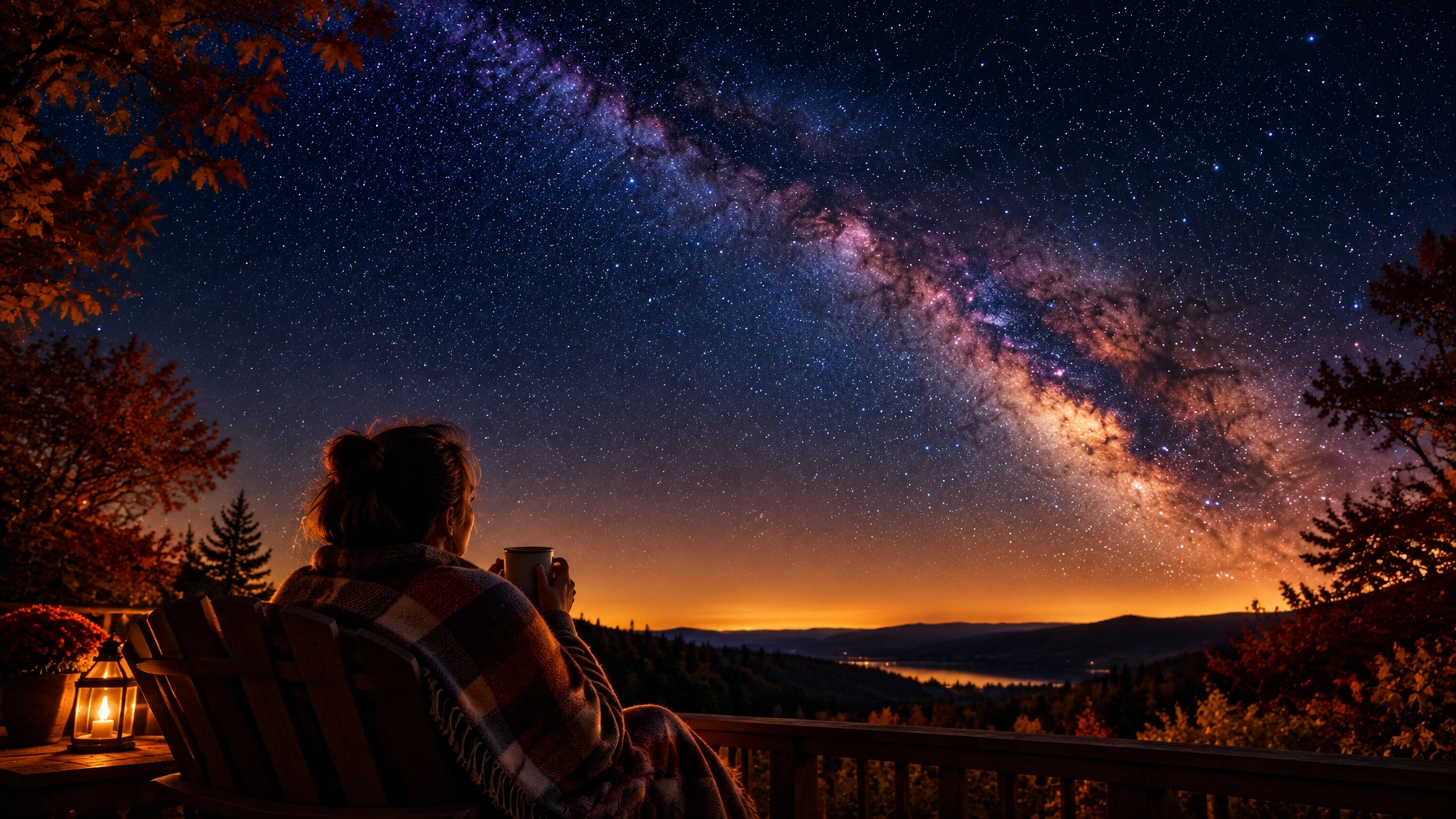
Look up this fall : the earlier sunsets are a gift to stargazers.
You do not have to stay awake until midnight to find something worth seeing. Saturn settles into the evening sky, the Moon brightens several autumn nights, and three meteor showers bring quick flashes of light before winter arrives.
This guide covers the key night sky events from October through December 2026. Every date and time is listed in US Eastern Time, and exact viewing times will vary by your location.
Pick one evening, step outside, and let the season unfold above you.
Start here: how to make any clear night better
You do not need a telescope for most of the events in this guide. A few simple choices will make the view easier:
- Find darkness: Move away from bright streetlights if you can.
- Give your eyes time: For meteor showers, allow at least 20 minutes for your eyes to adjust.
- Bring comfort: A chair, blanket, warm drink, and extra layers can turn a short look into a pleasant evening.
- Look broadly: Meteors can appear anywhere in the sky. You do not need to stare directly at their named constellation.
- Check the forecast: Clear skies matter more than perfect equipment.
For regular updates, visit our Tonight’s Sky guide. It is a simple way to see what is worth looking for each week.
October 4: Saturn reaches its best view of the year

Saturn reaches opposition on October 4. In plain English, Earth passes between Saturn and the Sun, putting the planet close to its brightest and largest appearance of the year.
At magnitude 0.3, Saturn looks like a steady, softly golden point of light. It will not twinkle as much as a star, which is one of the easiest ways to recognize it.
- What: Saturn at opposition : its brightest and biggest showing of 2026
- When: October 4; the best viewing window runs from late September through mid-October
- Where to look: Saturn rises around sunset, climbs highest in the southern sky around midnight, and sets near sunrise
- Best time: About 10:30 p.m. to 1:30 a.m. local time, when Saturn is highest and its view is steadier
- Gear: Your eyes are enough. A small telescope can reveal the rings, but it is completely optional
Any clear night in this window should offer nearly as good a view as opposition night itself. Look toward the east in the evening, then follow Saturn as it moves across the sky.
The rings are one of those sights that changes scale in your mind. From here, Saturn looks like a single point. Through a small telescope, that point becomes a world with a broad, unmistakable system of rings.
October 21–22: Watch for the Orionids

The Orionids are pieces of dust left behind by Halley’s Comet. When Earth moves through that trail, the particles burn up high in the atmosphere as brief streaks of light.
The peak night is October 21–22. This year, a waxing gibbous Moon will brighten the sky and wash out some of the fainter meteors. It is not likely to be the year’s best shower, but bright streaks may still appear : especially after moonset.
- What: The Orionids meteor shower
- When: Peak night of October 21–22; best after midnight
- Where to look: Broadly overhead; the radiant is near Orion, but meteors can appear anywhere
- Best conditions: The darkest sky you can find, especially after the Moon has set
- Gear: No telescope needed; a reclining chair or blanket is more useful
If you search for “meteor shower tonight,” remember that the peak is a window rather than a guarantee. You might see several meteors quickly, or you might wait a while for the next one. Give the sky time.
Look away from city lights, face whichever direction gives you the widest view, and keep your gaze relaxed. You are watching Earth move through the leftovers of a comet’s long journey around the Sun.
October 26: Meet the Hunter’s Moon

The Hunter’s Moon is the full Moon after the Harvest Moon. In 2026, it reaches full phase at 12:12 a.m. EDT on October 26.
The best time to enjoy it may be shortly after sunset, when the Moon rises near the horizon. It can look especially large and golden then. The Moon has not actually grown larger : this is a visual effect created by the way your brain compares it with trees, buildings, and the landscape.
- What: The Hunter’s Moon
- When: Full at 12:12 a.m. EDT on October 26; visible the night of October 25–26
- Where to look: Toward the eastern horizon around moonrise
- Best feature: Its warm color and low position make it especially lovely for a walk or a photo
- Gear: None needed
A clear evening walk is all the equipment this event requires. If you are introducing a child to stargazing, this is a comfortable place to begin: easy to find, bright enough to notice, and visible even from many suburban locations.
November 17–18: Give the Leonids a patient look
The Leonids arrive in mid-November, bringing fast meteors and the occasional bright fireball. They come from debris associated with Comet Tempel-Tuttle, although you do not need to know the comet’s name to enjoy the show.
A first-quarter Moon will interfere this year, so most of the fainter meteors will disappear in the moonlight. Brighter Leonids can still break through.
- What: The Leonids meteor shower
- When: Peak night of November 17–18; best after midnight
- Where to look: Broadly across the sky, with the radiant near Leo
- What to expect: Mostly brighter meteors, with a chance of very fast streaks or a fireball
- Gear: Naked eye viewing is best
The Leonids reward patience. Set up somewhere comfortable, look high above the horizon, and give yourself at least 20 minutes. Even one sudden bright streak can make the wait worthwhile.
November 24: Step outside for the Beaver Moon
The Beaver Moon reaches full phase at 9:53 a.m. EST on November 24, so the best opportunity to see it is the night of November 23–24.
This is a supermoon, meaning the full Moon occurs while the Moon is near one of its closest points to Earth. It can look slightly bigger and brighter than an average full Moon : a subtle difference, but a good excuse for a moonlit evening walk.
- What: The Beaver Moon, November’s full Moon and a supermoon
- When: Full at 9:53 a.m. EST on November 24; look on the night of November 23–24
- Where to look: East around moonrise, then across the southern sky later
- Best feature: A bright Moon rising over the horizon
- Gear: None needed
Try viewing it beside a familiar object such as a tree, rooftop, or nearby hill. The comparison gives the Moon a stronger sense of scale and makes the rise feel more dramatic.
December 13–14: Make time for the Geminids

The Geminids are the highlight of the fall : and possibly the year. Under ideal dark-sky conditions, this shower can produce up to about 150 meteors per hour.
The 2026 viewing conditions are favorable. A waxing crescent Moon will create only minimal interference, leaving the sky dark for many of the best viewing hours.
- What: The Geminids meteor shower
- When: Peak night of December 13–14; best after midnight
- Where to look: Broadly overhead; the radiant is near Gemini
- What to expect: Frequent, often bright meteors, with strong activity under dark skies
- Gear: No telescope needed; use a reclining chair, warm layers, and patience
To learn how to see a meteor shower, find the darkest practical location and let your eyes adapt for 20 minutes or more. Lie back and look up rather than focusing on one small patch of sky. The meteors may appear in front of you, behind you, or at the edge of your vision.
This is the night to use if you have been meaning to start stargazing. You can see the Geminids from a backyard, a park, or a quiet rural road : anywhere with a broad view and limited light pollution.
December 23: End the year with the Cold Moon
The final full Moon of 2026 arrives on December 23 at 8:28 p.m. EST. Its name fits the season: December brings long nights, low temperatures, and a Moon that often appears especially crisp in the cold air.
- What: The Cold Moon, the last full Moon of the year
- When: Full at 8:28 p.m. EST on December 23
- Where to look: Toward the east as it rises, then higher across the night sky
- Best feature: A bright winter Moon on one of the year’s longest nights
- Gear: None needed
The Cold Moon is a quiet closing scene after the busier meteor showers. Look up from a winter walk, a porch, or a window, and let the year’s final full Moon mark the change of season.
Your fall sky journey starts with one clear night
You do not need to catch every event. Start with Saturn, choose a full Moon, or set an early alarm for the Geminids. One successful night outside is enough to turn the sky from background scenery into something you recognize.
For more beginner-friendly guides, explore NOOMMED’s Beginner’s Corner or sign up for the free weekly newsletter. You will get the week ahead in the sky without the jargon : no spam, and you can unsubscribe anytime.
Pick one date, step outside, and let us know what you saw.
Clear skies.