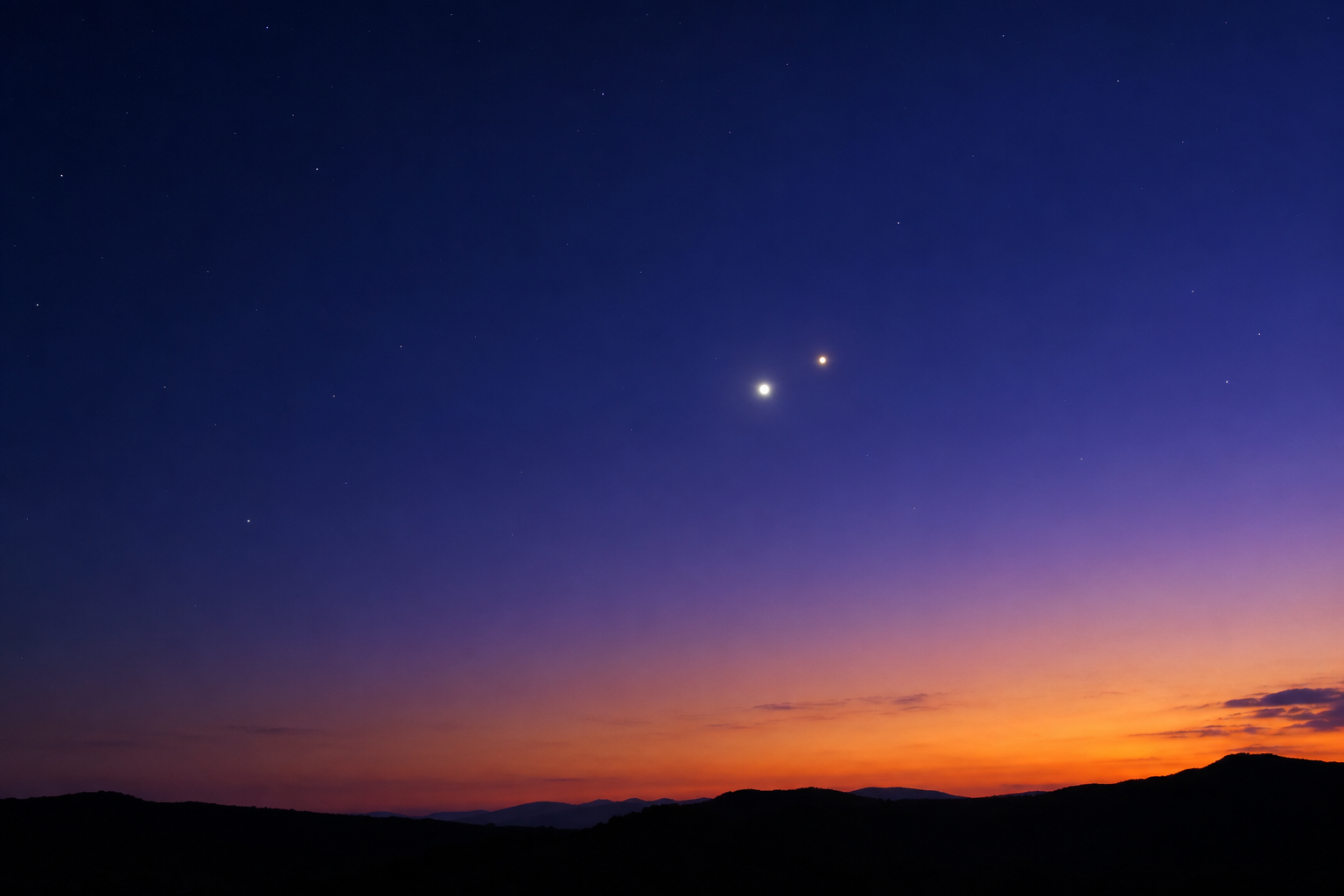
If you’ve glanced toward the western horizon just after sunset this week and thought “those are some unusually bright stars,” you weren’t looking at stars.
You were looking at Venus and Jupiter — the two brightest planets in our sky — currently locked in one of the closest pairings of the year. Astronomers call this a conjunction, which is a fancy word for “two objects look like they’re hanging out in the same patch of sky.” On the nights of June 8 and 9, 2026, the two planets appeared just a little more than one degree apart — about the width of your pinky finger held at arm’s length, according to The Planetary Society.
They’re still beautifully close all week. Here’s how to see them.
The TL;DR
- What: Venus and Jupiter, side by side
- When: ~30 minutes after sunset, through this weekend
- Where to look: Low in the west, just above where the sun went down
- Gear: None. Both planets are bright enough to pierce twilight.
Step outside about half an hour after sunset. While the sky is still that beautiful deep blue, look toward the west. The two brightest “stars” you see — and they will be obviously brighter than anything else — are Venus (the brighter of the two) and Jupiter. Venus shines at roughly magnitude −3.9, which is bright enough to cast a faint shadow on a dark night. Jupiter is no slouch either.
If you have binoculars, point them at Jupiter. On a steady night you can sometimes see four tiny dots arranged in a line beside it — those are the Galilean moons: Io, Europa, Ganymede, and Callisto. Galileo first saw them in 1610 and immediately understood that not everything in the sky revolves around Earth. You’re looking at the same four moons with the same eyes he used.
Cloudy where you are? BBC Sky at Night Magazine has photos from the peak nights, and conjunctions like this one happen often enough that another good pairing is rarely more than a few months away.
What’s next: The Strawberry Moon rises full on June 29. We’ll have a viewing guide up next week.
Clear skies.