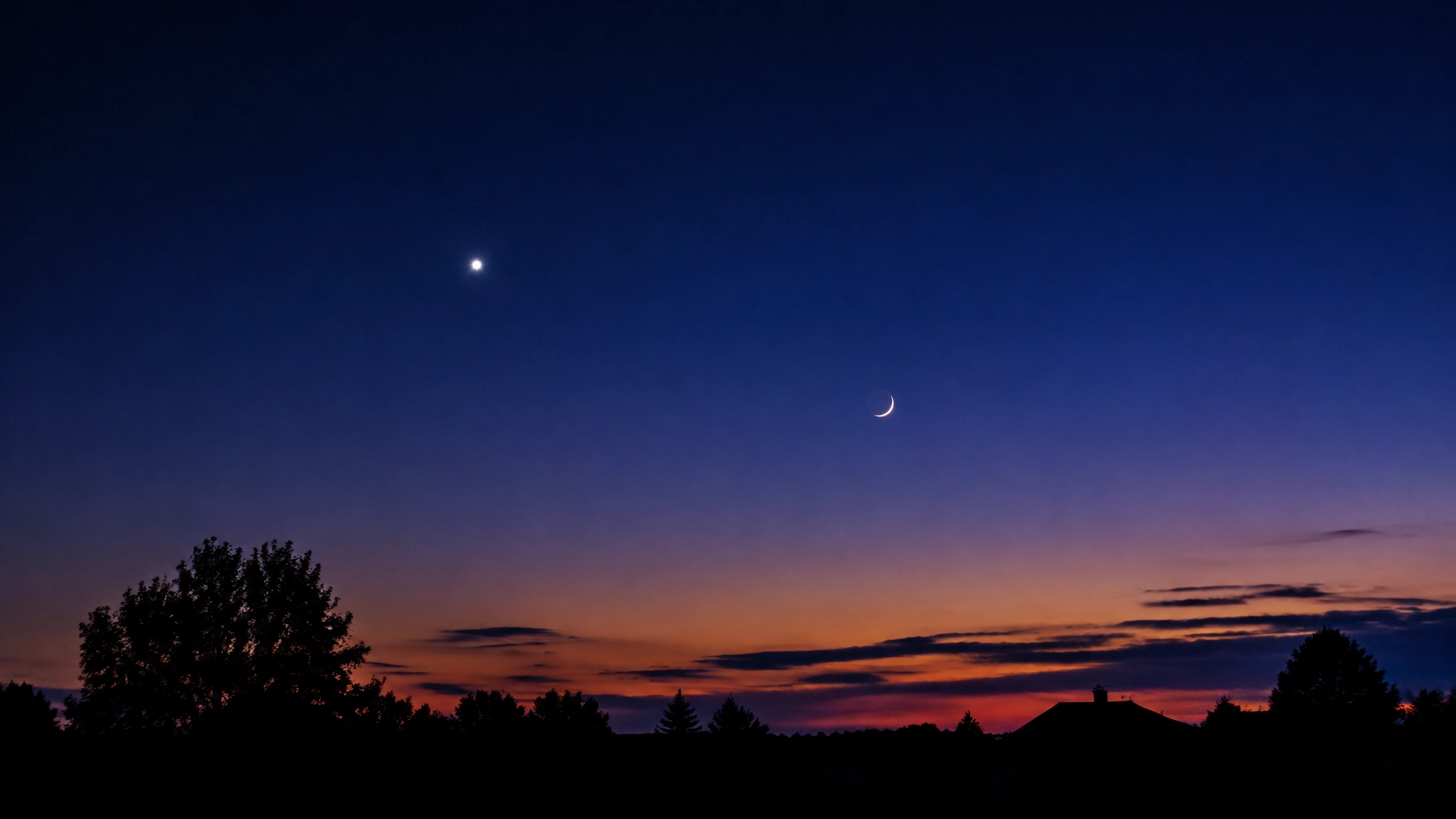
Look up tonight, Sunday, September 13, and you can spot four planets without a telescope , as long as you are willing to check the sky at different times.
Venus and a thin crescent Moon make the evening opening. Saturn appears later and stays visible for much of the night. Then, before sunrise, Mars and Jupiter take over the eastern sky.
The headline is simple: four planets are realistically visible tonight, but not all at once. Mercury is technically there too, although it is so close to the horizon that most observers will struggle to see it.
Here is your beginner-friendly guide to stargazing tonight.
Your quick planet plan for tonight
- What: Venus, Saturn, Mars, and Jupiter , with Mercury as a difficult extra
- When: Shortly after sunset, late evening, and before sunrise
- Where to look: West-southwest after sunset, east later at night, and east before dawn
- Gear: Your eyes are enough. Binoculars are optional for Mercury.
- Best feature: Venus beside the thin crescent Moon shortly after sunset
Exact times change with your location, trees, buildings, and horizon height. Think of the times below as a useful starting point rather than a promise down to the minute.
Start with Venus and the crescent Moon after sunset
Step outside about 20 minutes after sunset and look low toward the west-southwest.
Venus should be the easiest object to find. It shines much more brightly than the surrounding stars, earning its familiar nickname, the “Evening Star.” Tonight, a thin crescent Moon sits nearby, creating a simple pairing that is easy to appreciate even from a suburban backyard.
Venus is only about 8 degrees above the horizon 20 minutes after sunset in the reference sky chart from Astronomy magazine. That is roughly the width of your closed fist held at arm’s length, so you will need a clear view toward the horizon. The pair will not remain visible for long before they sink out of sight.
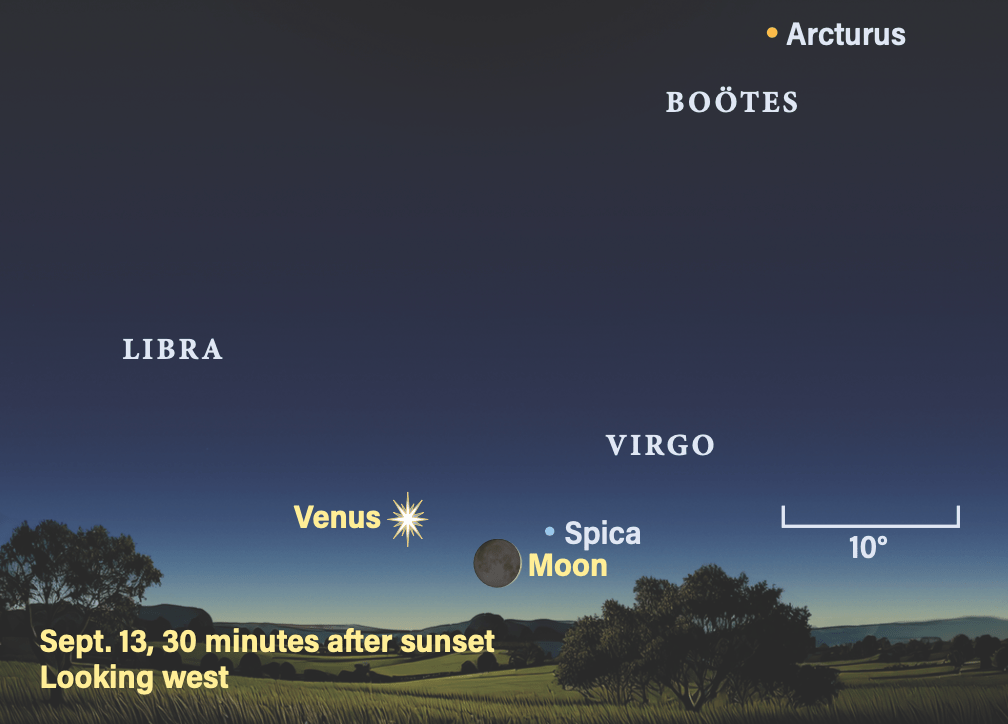
- What: Venus and the thin crescent Moon
- When: About 20 minutes after sunset
- Where to look: Low in the west-southwest
- Gear: Naked eye
- Tip: Find the Moon first if it is easier, then look for brilliant Venus nearby
Venus is approaching its greatest brilliance in the evening sky, so this is the night to use it as your guide. You may also notice the star Spica close to the pair, although it is much fainter and may be difficult to pick out in the remaining twilight.
If you have a clear, flat horizon, stay outside for a few extra minutes and see whether Mercury appears below or near the Moon. There is a catch.
Mercury is visible in theory , but very hard in practice
Mercury is only about 2 degrees above the horizon around 20 minutes after sunset. That is extremely low. Buildings, trees, haze, and ordinary horizon clutter can hide it completely.
It also disappears into the bright twilight quickly. You will need a very clear western horizon and excellent timing. Binoculars may help, but never use them while the Sun is still above the horizon or anywhere near your line of sight.
- What: Mercury
- When: Immediately after sunset, for only a short window
- Where to look: Extremely low in the west-southwest
- Gear: Binoculars may help, but they are not required for the main show
- Reality check: Most people will see Venus and the Moon, not Mercury
This is why we are not counting Mercury as part of tonight’s easy naked-eye lineup. It is a “possible,” not a promise.
Find Saturn when the sky gets properly dark
Later in the evening, turn around and face east.
Saturn rises at around 8:30 p.m. for many observers, although your exact time depends on location. It will look like a steady, softly golden point of light rather than a twinkling star. As the night continues, Saturn climbs higher and becomes easier to see.
Saturn remains visible for much of the night. Look toward the east at first, then follow it toward the southeast and south as the hours pass.
- What: Saturn
- When: Around 8:30 p.m. and through much of the night
- Where to look: East at first; southeast and south later
- Gear: Naked eye
- What to expect: A steady, star-like point with a subtle golden color
Tonight is also a useful preview of Saturn’s next big moment. The planet approaches opposition on October 4, when it will be at its biggest and brightest appearance of the year from Earth. Even now, you can find it without equipment. A telescope would reveal the rings, but that is an optional next step , not a requirement for joining in.
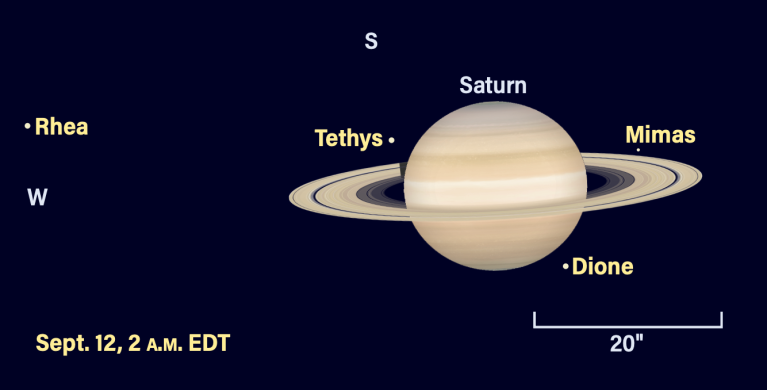
One quiet detail makes Saturn especially rewarding: the point of light you see is not near the stars around it. It is a separate world, nearly a billion miles away, appearing to sit among distant suns because the sky flattens enormous distances into one view.
Set an early alarm for Jupiter and Mars
If you want to complete tonight’s planet tour, set an early alarm.
In the hours before sunrise, look toward the east. Jupiter and Mars are both visible in the morning sky. Jupiter is the brighter and easier target, while Mars is fainter and may show a slight reddish or orange tint.
Start with the brightest star-like object in the eastern sky. That is likely Jupiter. Then search above and nearby for Mars. The planets will be easier to see once the sky is high enough above the horizon, but try to finish before dawn brightens the sky too much.
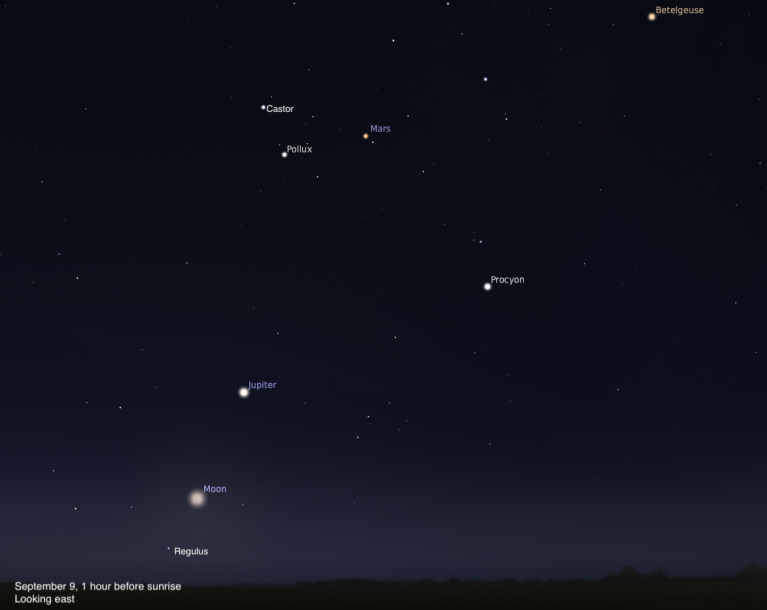
- What: Jupiter and Mars
- When: Before sunrise, during the early morning hours
- Where to look: East to southeast
- Gear: Naked eye
- Best approach: Find Jupiter first, then look for the fainter reddish point of Mars
Jupiter should stand out immediately. Mars takes a little more patience, especially if your sky is hazy or affected by city lights. Give your eyes several minutes to adjust and avoid looking directly at nearby porch lights or streetlamps.
How can you tell a planet from a star?
The easiest beginner’s clue is steady light.
Stars are so far away that their light often appears to shimmer or “twinkle” as Earth’s atmosphere moves. Planets are much closer, and they usually shine with a steadier glow. The difference is not perfect , some stars look calm, and planets can flicker when they are low , but it is a helpful first test.
Brightness is another clue:
- Venus is usually the brightest object in the evening sky after the Moon.
- Jupiter is often the brightest point in the morning sky.
- Mars can look faintly red or orange.
- Saturn tends to look steady and gently yellow.
- Mercury stays low and is easily lost in twilight.
If an object is bright, steady, and does not appear to move noticeably over a few minutes, it may be a planet.
So, are five planets visible tonight?
Technically, yes : but not as one five-planet lineup.
The September sky includes Venus, Mercury, Saturn, Mars, and Jupiter. They are spread across different parts of the day:
- Venus appears shortly after sunset.
- Mercury is also near the evening horizon, but is extremely difficult.
- Saturn rises later and remains visible for much of the night.
- Jupiter and Mars appear before sunrise.
For a relaxed, no-telescope observing session, count on Venus and Saturn in the evening, followed by Jupiter and Mars before dawn. That is four planets across one night : and a far more useful expectation than hoping to see five bright worlds together.
For additional skywatching ideas, keep an eye on NOOMMED’s Tonight’s Sky updates. We will keep translating the night sky into simple instructions: when to step outside, where to look, and what you are actually seeing.
Clear skies : and let us know which planet you found first.